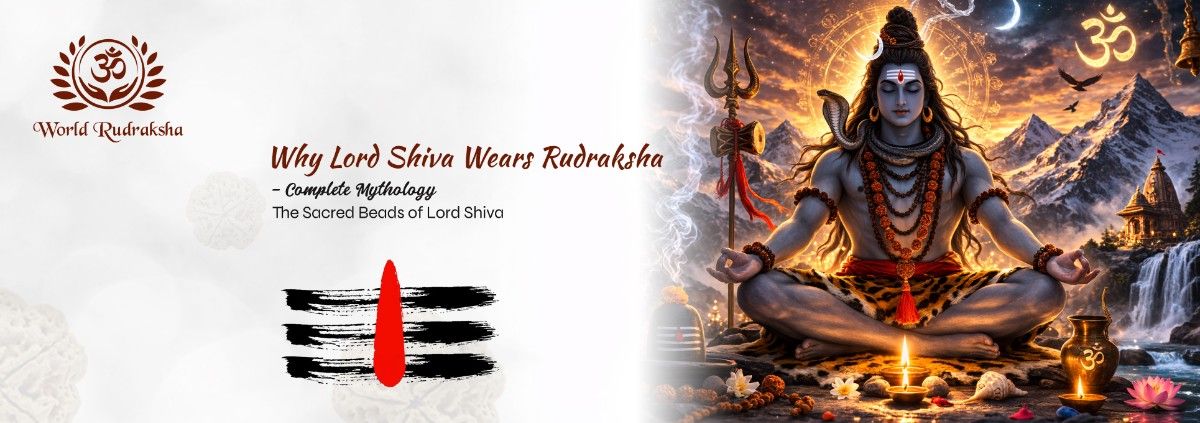
The Sacred Beads of Lord Shiva: Origin, Symbolism, and Spiritual Power
The origin of Rudraksha is deeply rooted in Hindu mythology and is primarily described in texts like the Shiva Purana and Devi Bhagavata Purana. The word Rudraksha is derived from two Sanskrit words: Rudra (a name of Shiva) and Aksha (tears). Thus, Rudraksha literally means “the tears of Shiva.” Why Lord Shiva Wears Rudraksha, as it symbolizes his eternal compassion, divine energy, and commitment to protecting devotees. According to legend, Lord Shiva once entered a state of profound meditation for the welfare of all beings.
After thousands of divine years, when he opened his eyes, tears of deep compassion rolled down onto the Earth and became Rudraksha seeds. These sacred tears crystallized into seeds, which later grew into the Rudraksha tree (Elaeocarpus ganitrus). Another version of the story connects Rudraksha to Shiva’s intense penance after destroying the demon Tripurasura. Having liberated the universe from evil, Shiva’s eyes filled with tears not of sorrow, but of cosmic compassion for all living beings still bound by ignorance and suffering. From these tears emerged Rudraksha beads as a tool for spiritual upliftment.
Thus, Rudraksha is not merely a botanical seed; it is considered a divine manifestation of Shiva’s grace. Devotees believe that wearing it creates a spiritual connection with Shiva’s energy, offering protection, clarity, and inner strength. The mythological origin establishes Rudraksha as a symbol of compassion born from divine consciousness. It represents Shiva’s eternal desire to help humanity transcend karma and attain liberation (moksha). By wearing Rudraksha, devotees symbolically carry Shiva’s tears close to their heart a reminder that divine compassion always surrounds them.
 Who is Lord Shiva?
Lord Shiva is one of the principal deities of Hinduism and a central figure of the Trimurti, alongside Brahma and Vishnu. Revered as Mahadev, or the Great God, Shiva embodies both destruction and transformation forces essential for cosmic renewal and spiritual evolution. In his aspect as Rudra, he manifests fierce cosmic energy, while as Adiyogi, he is recognized as the first yogi who taught humanity the science of yoga. Shiva represents detachment, meditation, and supreme consciousness, guiding devotees toward inner mastery.
He is often depicted in stillness atop Mount Kailash, smeared with sacred ash, adorned with serpents, and wearing Rudraksha beads, symbols of spiritual discipline, protection, and renunciation of material desires. His ascetic appearance reflects control over ego, desires, and illusion. Appreciating Shiva’s complex nature helps explain why Rudraksha, a sacred conduit of divine energy, is intrinsically linked to his identity and teachings.
 Why Lord Shiva Always Wears Rudraksha on His Body
In nearly every depiction of Lord Shiva, whether in sculptures, temple icons, or paintings, he is adorned with multiple Rudraksha malas around his neck, arms, wrists, and even within his matted hair. This is not mere ornamentation; it carries deep spiritual significance. Rudraksha beads are believed to have originated from Shiva’s own tears, symbolizing his compassion, purity, and cosmic responsibility. Unlike deities adorned with gold and jewels, Shiva chooses the simplicity of Rudraksha, emphasizing his identity as an ascetic and master of yogic discipline.
Energetically, Rudraksha radiates powerful vibrations that stabilize the mind and protect the aura. By wearing them, Shiva demonstrates mastery over ego, senses, and cosmic energies. For devotees, this teaches that true strength lies in spiritual awareness, discipline, and alignment with divine consciousness. Wearing Rudraksha becomes a pathway to emulate Shiva’s calmness, wisdom, fearlessness, and compassion.
Rudraksha as a Symbol of Detachment and Asceticism
Shiva, revered as the Adi Yogi, the first yogi, is the ultimate embodiment of renunciation and spiritual mastery. Unlike deities associated with wealth or celestial luxuries, Shiva dwells in the Himalayas, clothed in simplicity, smeared with ash, and adorned with Rudraksha. This natural adornment reflects a profound principle: detachment from the material world. Rudraksha beads, unpolished and earthy, signify vairagya, freedom from ego, desires, and worldly attachments.
By choosing Rudraksha over gold or jewels, Shiva demonstrates that true spiritual power arises from inner discipline, not external wealth. The rough texture of the beads reminds devotees that the spiritual path requires perseverance, meditation, and self-control. Rudraksha is closely linked to meditation and mantra chanting, complementing Shiva’s deep yogic focus. For devotees, wearing Rudraksha serves as a living reminder to cultivate detachment, humility, and simplicity. On Shiva’s body, it symbolizes renunciation, yogic discipline, and the ultimate freedom of the soul.
Aspect | Details |
Origin | Formed from Lord Shiva’s tears (Shiva Purana). |
Meaning | “Rudraksha” = Rudra (Shiva) + Aksha (Tears). |
Significance | Spiritual connection, protection, clarity, inner strength. |
Associated Deity | Lord Shiva – meditation, detachment, compassion. |
Symbolism | Detachment, divine protection, discipline, fearlessness. |
Mukhi Beads | 1 Mukhi – consciousness; 5 Mukhi – spiritual growth; others link to planets. |
Meditation | Enhances focus, breath control, mindfulness. |
Who Can Wear | Anyone—men, women, children, any faith. |
Rituals | Cleanse with water/milk, optional mantra chanting. |
Benefits | Spiritual protection, mental clarity, emotional balance, karmic cleansing. |
Rudraksha as Divine Protection
Shiva, the supreme protector, wears Rudraksha as a symbol of divine shielding. Born from his compassionate tears, Rudraksha carries his protective energy, safeguarding devotees from negativity, misfortune, and harmful influences. Beyond physical protection, it guards the mind against anger, jealousy, and anxiety, aligning the wearer with courage and calmness. Yogis and devotees wear Rudraksha malas like Shiva, emphasizing that spiritual awareness offers the strongest defense. Thus, Rudraksha is not just an ornament it represents fearlessness, divine grace, and the protective power of higher consciousness.
Rudraksha and Meditation
Shiva, the Adi Yogi, embodies perfect meditation. Rudraksha malas, worn by him, symbolize focus, stillness, and inner awakening. Used for mantra repetition, they help regulate breath, calm the mind, and enhance concentration. The rough texture reminds seekers that spiritual progress requires patience, discipline, and persistence.
By wearing Rudraksha, devotees align with Shiva’s meditative energy, cultivating mindfulness and inner peace. It is more than a counting tool it is a companion on the spiritual journey, teaching that true power arises from silence and awareness.
Different Mukhi Rudraksha and Their Meaning
Rudraksha beads are classified by mukhis (faces), each carrying unique vibrations and divine energy. Shiva wears multiple mukhis, symbolizing mastery over cosmic principles. The 5 Mukhi Rudraksha represents the five elements and spiritual growth, 1 Mukhi Rudraksha signifies pure consciousness, and 11 Mukhi Rudraksha connects to the eleven forms of Rudra.
Certain mukhis correspond to planetary influences, guiding devotees in spiritual and astrological matters. Shiva’s adornment illustrates harmony among cosmic forces, reminding wearers that Rudraksha is a sacred, purposeful structure, not just a natural seed.
Rudraksha and the Third Eye of Shiva
Shiva’s third eye symbolizes wisdom, insight, and the destruction of ignorance. Rudraksha, born from his tears, aligns with this symbolism. It balances the Ajna Chakra, enhancing intuition and clarity. The connection of tears (compassion) and the third eye (wisdom) shows that enlightenment merges knowledge with empathy.
Wearing Rudraksha reminds devotees to awaken inner consciousness, perceive truth, and dissolve ignorance. It is not just ornamentation but a spiritual tool to cultivate higher awareness, reflecting Shiva’s awakened state and guiding devotees toward clarity and insight.
Scientific and Energetic Interpretations of Rudraksha
Rudraksha is believed to possess subtle electromagnetic and energetic properties. Studies suggest it may influence the nervous system, reduce stress, and stabilize mental energy. Yogic traditions view it as balancing subtle energies and protecting against emotional disturbances. Shiva wearing Rudraksha demonstrates harmony between spiritual consciousness and natural law.
Whether approached scientifically or spiritually, Rudraksha bridges faith and experience, offering calmness, clarity, and a reminder that divinity is interconnected with the natural world. Its enduring relevance reflects both belief and transformative discipline.
Rudraksha in the Shiva Purana
The Shiva Purana emphasizes Rudraksha as dear to Shiva, granting spiritual merit to devoted wearers. Originating from his tears, each bead carries divine energy. The Purana describes bead types, mukhis, and their benefits, highlighting that touching, seeing, or chanting with Rudraksha reduces sins and negative karma.
This scriptural reference affirms Rudraksha’s sanctity, making it more than symbolic an authentic spiritual practice. Shiva wearing Rudraksha reinforces its divine significance, ensuring devotees experience protection, guidance, and the blessings of Mahadeva
Why Rudraksha is Sacred for Devotees
Rudraksha is sacred as it embodies Shiva’s compassion and divine energy. Naturally formed and spiritually energized through mantras, it connects devotees directly with the divine. Wearing it fosters discipline, reduces negative habits, and strengthens devotion. Its sacredness depends on intention, not mere ornamentation, making it a living spiritual companion.
Shiva’s association elevates Rudraksha as a symbol of grace, ethical alignment, and divine remembrance, reminding devotees to remain humble, conscious, and aligned with dharma in daily life.
Astrological Significance of Rudraksha
Rudraksha beads influence planetary energies according to Vedic astrology. Shiva wearing Rudraksha signifies alignment with cosmic forces, helping devotees balance planetary doshas and karma. Specific mukhis correspond to planets and elements, guiding spiritual growth, protection, and mental clarity.
Wearing Rudraksha with devotion is believed to harmonize mind, body, and destiny. This astrological connection underscores why Shiva’s choice of beads is purposeful, not ornamental, offering devotees a way to integrate divine energy with personal and cosmic alignment.
Who Can Wear Rudraksha?
Rudraksha is universal; anyone, regardless of gender or age, can wear it with respect and guidance. Shiva’s wearing demonstrates gender neutrality and spiritual inclusivity. The benefits are spiritual, mental, and physical, accessible to all who approach it with devotion.
Proper selection of mukhi beads ensures alignment with individual needs and planetary influences. Following rituals and maintaining mindfulness allows the wearer to harness the full protective and transformative power of Rudraksha
Rituals Before Wearing Rudraksha
Before wearing Rudraksha, devotees cleanse it with water or milk and energize it with mantras, most commonly “Om Namah Shivaya.” Rituals may include meditation, prayer, or chanting to establish a spiritual connection. This sanctifies the bead, allowing it to channel divine energy effectively. Shiva wearing Rudraksha is a reminder that sacred objects must be treated with reverence.
Observing rituals strengthens devotion, mindfulness, and spiritual alignment, ensuring the bead functions as a true companion on the path to self-realization
Conclusion
Shiva wears Rudraksha as a timeless symbol of compassion, detachment, protection, and spiritual awakening. Born from his sacred tears, the bead represents divine grace manifested in nature. It reflects Shiva’s identity as the supreme yogi: simple, fearless, and beyond material attachment.
For devotees, Rudraksha is more than an ornament; it is a reminder to live mindfully, act righteously, and seek higher consciousness. By wearing it with sincerity and discipline, one aligns with Shiva’s teachings and moves closer to inner peace, strength, and ultimately, liberation (moksha).