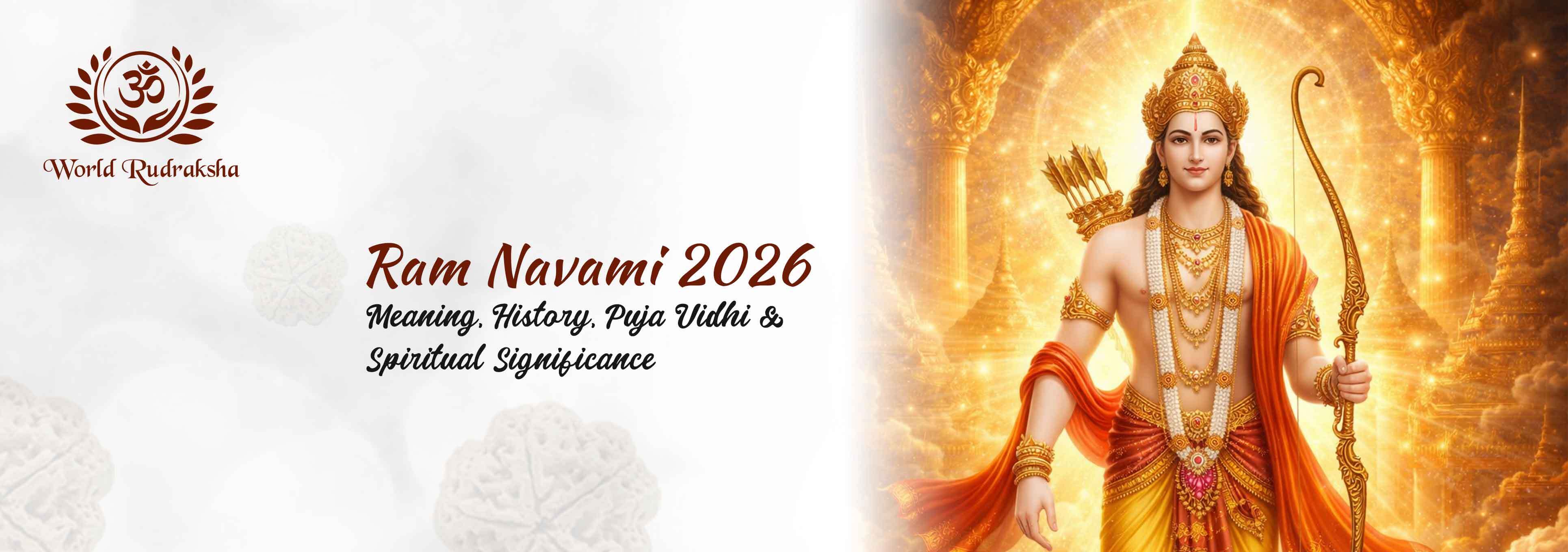
Celebrate the birth of Lord Rama with devotion, learn the Puja Vidhi, rituals, and explore the spiritual significance of this sacred festival.
Ram Navami is one of the most sacred and joyfully celebrated festivals in the entire Hindu calendar. Observed on the ninth day Navami of the bright fortnight of the month of Chaitra, it marks the divine birth of Lord Rama, the seventh avatar of Lord Vishnu, the hero of the immortal Ramayana, and the eternal symbol of righteousness, truth, and selfless love.
In 2026, Ram Navami falls on Thursday, 26 March a deeply auspicious day that invites every devotee to pause, reflect, and reconnect with the timeless ideal that Lord Rama embodies: a life lived in complete truth, complete courage, and complete devotion to the divine. Whether you observe it through elaborate ritual or simple, heartfelt prayer, Ram Navami is an opportunity to bring the light of Rama's consciousness into your own life.
Meaning of Ram Navami Ram
 The name Ram Navami combines two Sanskrit words 'Ram' (Lord Rama) and 'Navami' (the ninth day of the lunar fortnight). But the meaning of this festival runs far deeper than a birthday celebration.
Lord Rama is revered throughout the Vedic tradition as Maryada Purushottam 'the most excellent among men who upholds the boundaries of righteousness.' He lived his entire life through exile, heartbreak, war, and personal sacrifice in perfect alignment with dharma. He never lied. He never abandoned a promise. He treated every being from great kings to humble forest animals with equal dignity and genuine love.
Ram Navami, therefore, is a celebration not merely of a birth but of an ideal the possibility of a human life lived in complete integrity, boundless compassion, and unwavering devotion. In celebrating it, every devotee reaffirms their own aspiration to live with greater truth and greater love.
Navami 2026: Key Details
| Detail | Information |
|---|---|
| Date | Thursday, 26 March 2026 |
| Vaishnava Ram Navami | Friday, 27 March 2026 |
| Tithi | Navami, Shukla Paksha, Chaitra |
| Most Auspicious Time | 11:13 AM – 1:41 PM |
| Deity | Lord Rama — 7th Avatar of Vishnu |
| Primary Mantra | Om Sri Ramaya Namah |
History and Mythology: The Birth of Lord Ram
 The story of Rama's birth is told with great love in the Valmiki Ramayana, the Adhyatma Ramayana, and the Ramcharitmanas of Goswami Tulsidas. The world had fallen under the shadow of the demon king Ravana a being of immense power who had obtained extraordinary boons from Lord Brahma through fierce austerities, and used them to terrorise the three worlds. The gods, helpless before him, approached Lord Vishnu and pleaded for intervention.
Lord Vishnu, moved by compassion for all beings, agreed to descend to earth not as a supernatural force, but as a human being who would restore dharma through the full depth and dignity of human virtue. He chose to be born as the son of King Dasharatha of Ayodhya, the beloved and righteous ruler who had three queens but no children.
King Dasharatha performed the great Putrakameshti Yajna a sacred fire ritual conducted by the sage Rishyashringa to seek the blessing of children. The gods responded with a divine gift of sacred pudding (Payasam) distributed to his three queens. On the ninth day of the bright fortnight of Chaitra, at the auspicious midday hour known as Madhyahna, Queen Kaushalya gave birth to Lord Rama in the royal palace of Ayodhya. The heavens showered flowers, celestial musicians played, and a profound peace descended upon the earth.
Rama grew up to be the most perfect prince Ayodhya had ever known trained in warfare by the sage Vishwamitra, wedded to the divine Sita, and beloved by all. But it was his fourteen years of forest exile endured without complaint, without bitterness, and without abandoning a single principle that revealed the full depth of his dharmic character. The Ramayana, in its entirety, is the story of what happens when pure divine consciousness chooses to live as a human being fully, completely, and without reservation.
Ram Navami 2026: Date and Auspicious Timings
Ram Navami 2026 is celebrated on Thursday, 26 March. The Navami tithi begins on the morning of 26 March and extends into the morning of 27 March which is observed as Vaishnava Ram Navami.
The most spiritually potent period of the day is the Madhyahna window 11:13 AM to 1:41 PM which corresponds to the sacred midday hour when Lord Rama is believed to have been born. Puja and mantra recitation performed during this period carry extraordinary grace and blessing.
Complete Ram Navami Puja Vidhi What
You Will Need
- Image or murti of Lord Rama (with Sita, Lakshmana, and Hanuman)
- Fresh flowers marigold, jasmine, lotus
- Tulsi (holy basil) leaves the most sacred offering to Lord Vishnu
- Panchamrit milk, curd, honey, ghee, and sugar
- Pure water, sandalwood paste, kumkum, akshat (unbroken rice)
- Ghee lamp and incense
- Fruits and sweets for Prasad offering
- Rudraksha or Tulsi mala for mantra counting
Step-by-Step Puja
- Wake before sunrise. Bathe and wear clean yellow or saffron clothing.
- Clean your puja space and set up the altar with the image of Lord Rama on a yellow cloth decorated with flowers.
- Light the ghee lamp and incense. Begin with three chants of 'Om Gam Ganapataye Namah' to invoke Lord Ganesha.
- Perform Abhishek gently bathe the murti with Panchamrit, then with pure water, then rose water. Wipe clean with a soft cloth.
- Offer sandalwood paste to the forehead of the murti, followed by fresh flowers and Tulsi leaves at Rama's feet.
- Offer fruits and sweets as Naivedya (food offering). Chant 'Om Sri Ramaya Namah' 108 times with your mala.
- Recite the Ram Raksha Stotra and selected verses from the Ramayana's Bal Kanda (the chapter of Rama's birth).
- Perform the Ram Aarti singing with full devotion, ideally with the entire family.
- Conclude with a moment of silent prayer and meditation. Distribute Prasad to all present.
Ram Navami Fasting
Fasting on Ram Navami is widely observed from sunrise until the completion of the midday puja. Traditionally, there are three levels of fasting:
- Complete Fast (Nirjala) :Devotees abstain from both food and water. This is for the most committed practitioners.
- Fruit and Milk Fast :Only water, fresh fruits, and milk are consumed. This is the most commonly observed form of fasting.
- Sattvic Food Fast :Grains, onions, garlic, and non-vegetarian food are avoided. This type is suitable for those with health considerations or work commitments.
Sacred Mantras of Ram Navami
Primary Mantra
Om Sri Ramaya Namah
This is the fundamental mantra of Lord Rama, typically chanted 108 times using a mala. “Sri” invokes auspiciousness and the grace of Goddess Lakshmi (incarnated as Sita), “Ramaya” means “to Rama,” and “Namah” means “I bow in surrender.” It forms the cornerstone of all Ram Navami practices.
Rama Taraka Mantra
- Sri Rama Rama Rameti, Rame Rame Manorame
- Sahasranama Tattulyam, Rama Nama Varanane
Found in the Padma Purana, this mantra highlights that chanting “Rama” three times equals reciting the thousand names of Lord Vishnu. Holding the name “Rama” in the heart with devotion is considered the greatest mantra of this age.
Maha Mantra
- Hare Rama Hare Rama, Rama Rama Hare Hare
- Hare Krishna Hare Krishna, Krishna Krishna Hare Hare
The Mahamantra of the Vaishnava tradition chanted in joyful group kirtan on Ram Navami, filling homes and temples with the vibration of divine love. The Hare Rama portion is especially emphasised on this sacred day.
Rudraksha and Ram Navami
Rudraksha beads are sacred and deeply connected to Lord Shiva. Wearing Rudraksha on Ram Navami is believed to enhance spiritual energy and strengthen devotion to Lord Rama.
These divine beads are known to calm the mind, improve focus, and protect against negative influences. On such an auspicious day, Rudraksha is said to amplify the power of prayers and meditation, helping devotees feel more connected and centered.
Among them, the 5 Mukhi Rudraksha is considered ideal for peace, balance, and mental clarity, while the 11 Mukhi Rudraksha is associated with courage, confidence, and protection. When worn with faith and sincerity, Rudraksha can deepen one’s spiritual journey, bringing inner stability, positivity, and a sense of harmony in life.
Spiritual Significance of Ram Navami
The deepest teaching of Ram Navami is not found in ritual alone. It is found in the life of Rama himself a human being who demonstrated, through every choice and every sacrifice, that the divine does not live somewhere distant and unreachable. It lives within us, as the deepest potential of our own human consciousness.
Lord Rama experienced everything that human beings experience love and loss, loneliness and belonging, the burden of leadership and the pain of separation. He met each experience with a quality of consciousness that never wavered in its truth, its love, or its alignment with the divine will. Ram Navami is an annual invitation to ask: how can I bring more of that quality into my own life?
The great saint Tulsidas taught that the name of Rama is itself the highest spiritual practice available in the current age greater than any ritual, any austerity, or any pilgrimage. On Ram Navami, even a few sincere minutes spent quietly repeating 'Rama, Rama' with an open heart is a complete spiritual practice one that carries the full blessing of the festival and the grace of the Lord himself.
Ram Navami also calls us back to the dharmic values that Rama embodied:
- Satya: truth in every word and action
- Dharma: the courage to do what is right, even at personal cost
- Karuna: compassion for every being without exception
- Bhakti: love and devotion as the highest path to the divine
These are not values of the past. They are the values that the world most needs today and Ram Navami is our annual reminder that they are possible, that they have been lived fully and beautifully by one who walked this earth, and that they remain available to every human heart that sincerely seeks them.
Conclusion
Ram Navami 2026 Thursday, 26 March is a sacred gift in the midst of the ordinary calendar: a day when the veil between the human and the divine grows thin, and the presence of Lord Rama becomes especially close and accessible to every sincere heart.
Whether you celebrate with an elaborate home puja, a visit to a Ram temple, the reading of a beloved passage from the Ramayana, or simply a few quiet minutes of chanting 'Om Sri Ramaya Namah' what matters most is the sincerity of your heart and the genuineness of your aspiration. Rama, who walked fourteen years in the forest with nothing but his bow and his integrity, asks nothing more from his devotees than a sincere and open heart.
May the grace of Lord Rama bless you and your family with truth, harmony, courage, and boundless love not only on Ram Navami, but in every moment of the year ahead.