Nepal vs Indonesia Rudraksha: Size, Texture, Price, Authenticity & Spiritual Value
When buyers search for Nepal vs Indonesia Rudraksha, they are usually trying to understand three main things: the difference in appearance, the difference in spiritual value, and which Rudraksha is better for them. Both Nepali and Indonesian (Java) Rudraksha come from the same botanical species, yet they differ in size, texture, density, and market pricing. These variations create confusion in the marketplace, especially for first-time buyers.
Nepali Rudraksha beads are generally larger, heavier, and have deeper mukhi (natural lines), while Indonesian beads are typically smaller, smoother, and lighter in weight. Because of these visible differences, many assume there must also be a difference in spiritual power. However, traditional scriptures do not distinguish spiritual benefits based on country of origin.
Instead, they emphasize the number of mukhis and the sincerity of the wearer. The question “Which Rudraksha is better?” depends on purpose, preference, and budget. If someone prefers bold, prominent beads for malas or spiritual display, Nepali beads may appeal more. If comfort, lightweight wear, or affordability is a priority, Indonesian beads may be more suitable. This comparison aims to provide a balanced, unbiased understanding based on botanical facts, traditional beliefs, scientific viewpoints, and market realities so buyers can make an informed spiritual and practical decision.
Botanical Overview of the Rudraksha Tree (Elaeocarpus ganitrus)
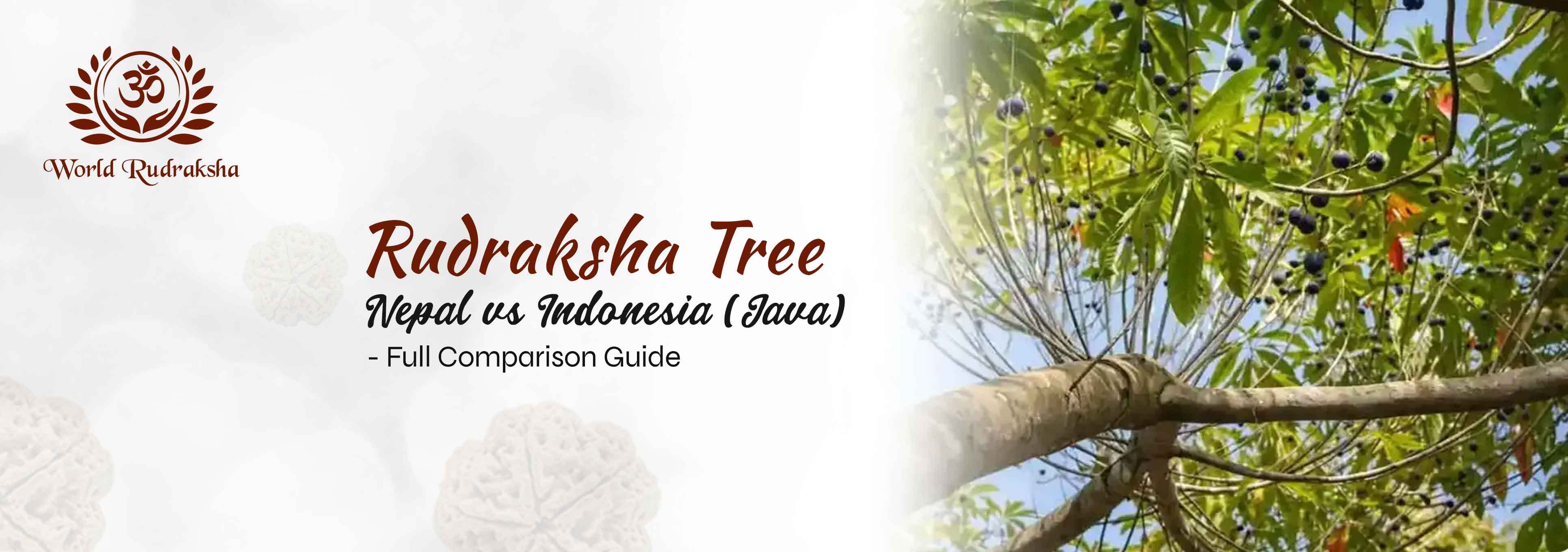
 Rudraksha beads come from the tree scientifically known as Elaeocarpus ganitrus. This evergreen tree grows primarily in parts of South Asia and Southeast Asia, including Nepal and Indonesia. The tree can reach heights of 50 to 80 feet and produces blue-colored fruits. Inside each fruit lies the hard seed that becomes the sacred Rudraksha bead.
Botanically, Nepali Rudraksha and Indonesian Rudraksha originate from the same species. There is no genetic difference separating them into two distinct categories. However, environmental conditions influence how the seed develops. Factors such as altitude, soil mineral content, humidity, and rainfall contribute to variations in bead size and surface texture.
The fruit matures over several months. Once ripe, it falls naturally from the tree, after which the pulp is removed, and the seed is cleaned and dried. The vertical lines known as mukhis are natural divisions formed during seed development. These lines cannot be artificially created without damaging the bead’s internal structure.
Because both Nepal and Indonesia produce Rudraksha from the same species, any perceived difference in spiritual energy is based on belief and tradition rather than botanical distinction. Scientifically speaking, the origin affects physical characteristics more than biological classification.
Understanding this botanical foundation is essential before comparing size, density, and market value, as it clarifies that all authentic Rudraksha beads share the same natural origin.
Geographic Growing Conditions – Nepal vs Java
The environment in which a Rudraksha tree grows plays a significant role in shaping the bead’s physical characteristics. In Nepal, Rudraksha trees grow in the lower Himalayan region, typically at moderate altitudes with cooler climates and mineral-rich soil. These conditions contribute to slower seed development, often resulting in larger and more deeply grooved beads.
In contrast, Indonesian Rudraksha primarily grows in tropical regions, especially on the island of Java within Indonesia. The warm, humid, sea-level climate encourages faster growth cycles. As a result, the beads are generally smaller, lighter, and have finer surface textures.
Nepal’s mountainous terrain provides fluctuating temperatures and distinct seasonal patterns, which may influence denser seed formation. Indonesia’s stable tropical climate offers consistent rainfall and humidity, allowing large-scale cultivation.
Soil composition also differs. Himalayan soil tends to contain varied mineral deposits due to geological activity, while volcanic soil in Indonesia provides rich organic content. Both environments are suitable for Rudraksha cultivation, but they produce visually distinct beads.
These environmental factors explain the physical differences seen in the global market. However, they do not create a different species or scriptural category. Geography influences appearance and density, not spiritual classification.
Size & Physical Appearance Comparison
One of the most noticeable differences between Nepali and Indonesian Rudraksha is size. Nepali beads are generally larger, often ranging from 14mm to 45mm in diameter. Indonesian beads, especially from Java, typically range from 3mm to 25mm. This size variation directly affects weight and visual presence.
Nepali Rudraksha usually appears rounder, with a rough and bold surface. The mukhi lines are thick and deeply carved by nature, making them easy to count. Indonesian beads are smaller and smoother, with thinner and more refined lines. Their compact size makes them comfortable for daily wear, especially in full malas.
Weight is another distinguishing factor. Larger Nepali beads feel heavier in the hand and around the neck, which some practitioners prefer for grounding during meditation. Indonesian beads, being lighter, are ideal for long-term wearing without discomfort.
Texture differences are also visible. Nepali beads tend to have a rugged, earthy appearance, while Java beads often display a smoother outer layer.
These visual distinctions influence buyer perception and pricing. Larger beads are often considered premium due to rarity and demand. However, appearance alone does not determine authenticity or spiritual effectiveness.
Ultimately, the choice between the two depends on comfort preference, aesthetic appeal, and intended use.
Mukhi Line Clarity & Natural Formation
The mukhi lines are the most critical identifying feature of a Rudraksha bead. These natural vertical clefts run from one end of the bead to the other and determine its classification. Nepali Rudraksha beads are known for having deeper, wider, and more clearly visible mukhi lines. Because of their larger size, the segmentation appears bold and easily distinguishable.
Indonesian (Java) Rudraksha beads also possess natural mukhi lines, but due to their smaller size and smoother surface, the lines often appear thinner and more refined. This sometimes leads inexperienced buyers to assume they are artificial or less powerful, which is incorrect. The mukhi formation is entirely natural in both origins.
The depth of lines in Nepali beads is influenced by slower growth cycles in Himalayan conditions, while faster tropical growth in Indonesia may result in subtler segmentation. However, clarity does not equate to superiority. Authenticity depends on whether the lines are natural and unaltered, not their thickness.
Artificial carving is sometimes used in fraudulent markets to create rare mukhi types. Therefore, buyers should inspect the continuity of lines from one pole to the other. Natural mukhis will always run uninterrupted and show internal compartment alignment.
Understanding mukhi clarity helps buyers make informed decisions, especially when searching for “original Nepali Rudraksha identification” or comparing bead authenticity.
Feature | Nepal Rudraksha | Indonesian (Java) Rudraksha |
Botanical Species | Elaeocarpus ganitrus | Elaeocarpus ganitrus |
Growing Region | Himalayan region of Nepal | Tropical regions of Indonesia (mainly Java) |
Size | Larger (approx. 14mm–45mm) | Smaller (approx. 3mm–25mm) |
Weight | Heavier and denser | Lighter and compact |
Surface Texture | Rough, bold, deeply grooved | Smoother, finer texture |
Mukhi Lines | Thick, deep, clearly visible | Thinner, more refined lines |
Internal Structure | Well-defined compartments (visible in X-ray) | Natural compartments, compact structure |
Spiritual Classification | Based on mukhi, not origin | Based on mukhi, not origin |
Scriptural Difference | No origin-based distinction | No origin-based distinction |
Comfort for Daily Wear | Slightly heavy for long wear | More comfortable for everyday use |
Durability | Very durable due to size and thickness | Durable when properly maintained |
Availability | Limited production | Large-scale cultivation and export |
Market Price | Generally higher | More affordable |
Best For | Ritual use, bold malas, collectors | Daily wear, lightweight malas, budget buyers |
Authenticity Check | Natural mukhi lines + lab certification | Natural mukhi lines + lab certification |
Internal Structure & Density Differences
Beyond surface appearance, the internal structure of Rudraksha plays an important role in authenticity verification. Each authentic bead contains natural compartments corresponding to its mukhi count. These compartments are formed organically during seed development.
Nepali Rudraksha beads are generally denser and thicker due to their larger size. When examined through X-ray imaging, their internal chambers appear well-defined and proportionally spaced. Indonesian beads also show natural compartment structures, but because they are smaller, the chambers are compact.
Density affects weight and sometimes durability. Some traditional practitioners believe denser beads hold stronger vibrational properties, though this is a spiritual interpretation rather than a scientifically proven fact.
Natural holes running through the bead are another indicator. Authentic Rudraksha develops a central channel. Artificial drilling may widen it, but the original pathway exists naturally.
From a buyer’s perspective, internal structure verification through lab certification is one of the most reliable ways to confirm authenticity. Density differences reflect environmental growth, not spiritual hierarchy.
Energy & Spiritual Beliefs
Traditional beliefs often associate Nepali Rudraksha with stronger “Himalayan energy.” The sacred geography of Nepal, close to Mount Kailash, the mythological abode of Lord Shiva, adds to this perception. Many spiritual practitioners prefer Nepali beads for meditation and ritual use.
Indonesian Rudraksha, however, is widely used by yogis across Southeast Asia and India. Scriptures do not state that one origin carries more spiritual power than another. Spiritual effectiveness depends primarily on mukhi type and the devotion of the wearer.
The belief that Nepali beads vibrate more intensely comes from their size and tactile presence. Larger beads may feel more substantial, influencing psychological perception.
Balanced understanding is important. Spiritual value is rooted in faith, discipline, mantra practice, and authenticity, not geography alone.
Scientific & Laboratory Perspective
From a scientific standpoint, both Nepali and Indonesian Rudraksha originate from the same species and share similar organic composition.
Laboratory analysis focuses on density, natural compartment count, and absence of artificial carving.
X-ray testing is commonly used to verify internal chambers.
Water tests are unreliable and not recommended for serious authentication.
Scientific evaluation confirms structural integrity rather than spiritual potency.
No scientific research conclusively proves that origin determines energetic superiority.
However, density and maturity of seeds can influence durability.
Laboratory certification enhances buyer confidence, especially in premium purchases.
In modern markets, scientific validation is becoming increasingly important alongside spiritual belief.
Durability & Longevity Comparison
Durability depends on maturity, density, and care rather than origin alone. Nepali beads, being larger and thicker, are generally more resistant to cracking. Indonesian beads, though smaller, are still durable if properly maintained. Climate exposure can affect longevity. Excess moisture, chemical contact, or improper storage may damage any Rudraksha bead. Regular oiling and careful handling increase lifespan significantly. Both origins can last decades when preserved correctly.
Price Comparison
Nepali Rudraksha typically commands higher prices due to larger size, limited production, and strong market demand. Indonesia produces Rudraksha on a larger agricultural scale, making them more affordable. Price is influenced by mukhi rarity, bead size, and certification. A rare mukhi from either origin can be expensive. Market perception plays a major role. “Nepali origin” often carries premium branding value.
Availability & Global Export
Indonesia leads in global export volume due to large-scale cultivation. Nepal’s production is more limited and seasonal. Indonesian beads are widely available internationally, while genuine Nepali beads may be harder to source in bulk. Availability affects pricing and distribution patterns in global markets.
Astrological & Scriptural Perspective
Scriptures classify Rudraksha by mukhi, not by country. No ancient text differentiates energy based on geographic origin. Astrological recommendations focus on planetary associations of mukhis rather than origin. Therefore, spiritual suitability depends on bead type, not country.
How to Identify Genuine Nepal vs Java Rudraksha
Identification includes checking size, texture, mukhi continuity, and certification. Nepali beads are generally larger with deeper grooves. Java beads are smaller and smoother. Lab reports confirming internal compartments provide strong authenticity assurance. Buyers should prioritize genuineness over origin marketing.
Which One Is Better for You?
If you prefer larger, bold beads for ritual use, Nepali Rudraksha may suit you. If comfort, affordability, and lightweight wear are priorities, Indonesian beads may be better. Spiritual growth depends on intention and practice, not size alone.
Myths & Marketing Misconceptions
Nepal Rudraksha is often preferred by those seeking quicker and more intense results in meditation or spiritual practice. Common myths like “Nepal is always stronger” or “Java Rudraksha is fake” are false. Authenticity depends on natural formation, mukhi lines, and certification, not origin. Price differences reflect rarity and market demand, sometimes exploited by sellers. Both Nepal and Indonesian Rudraksha are genuine when naturally formed, and their effectiveness relies on devotion, intention, and proper care rather than geographic source. A balanced understanding ensures informed and mindful purchasing decisions.
Verdict + Expert World Rudraksha Recommendation
Both Nepali and Indonesian Rudraksha are authentic when naturally formed and properly certified. Physical differences arise from environmental conditions, not spiritual hierarchy. The best Rudraksha is one that is genuine, suitable for your spiritual needs, and worn with devotion. Focus on mukhi type, authenticity testing, and personal comfort rather than marketing hype.
Conclusion
The comparison between Nepal and Indonesia (Java) Rudraksha often creates confusion in the spiritual marketplace. While physical differences in size, texture, and density are clearly visible, both types originate from the same sacred tree species and share the same scriptural significance. Environmental conditions influence appearance but not spiritual authenticity.
Nepali Rudraksha beads are typically larger, heavier, and visually bold, making them popular for malas and traditional spiritual display. Indonesian beads, being smaller and lighter, are ideal for daily wear and affordability. However, no ancient scripture states that one origin holds greater spiritual power than the other. The true effectiveness of Rudraksha depends on its mukhi type, natural formation, authenticity, and the devotion of the wearer.
When choosing a Rudraksha, focus on verified authenticity, proper mukhi classification, and personal comfort. Avoid marketing myths that exaggerate origin-based superiority. A genuine Rudraksha, whether from Nepal or Indonesia, becomes spiritually powerful when worn with sincerity, discipline, and faith.